21 April 2008

Brogue Master Ritual

A troubled career as a schoolboy may for some be cause for shame, but for me it opened up an unimagined world. Following my expulsion from school due to my involvement in what later became known as the Mayonnaise Affair (about which I have written elsewhere), it was decided I would complete my studies with a private tutor. Mr. Regelous was an ex-Jesuit priest from South Africa who specialised in the academic rehabilitation of wayward boys from the Catholic public schools.
Mr. Regelous was a large, blonde-haired chap with a broken nose and the physique of a rugby player, which, considering he played at school and at university, made perfect sense. After coming down from Oxford (Campion Hall) he had spent a few years on assignment in Rhodesia. His duties gave him enough time for other pursuits, including an interest in native wildlife. Mr. Regelous became somewhat of an expert on reptiles, I later discovered, and his detailed observations of the Cape Cobra (Naja nivea) in Southern Africa were published in the scientific journals of the British Herpetological Society. The rigors of ministry and missionary work, however, eventually alienated him from priestly life. He returned to England and took up tutoring.
Based at Marlow, Mr. Regelous had under his guidance several boys in the area. He followed a traditional curriculum with a focus on the Classics. I thrived in his care. Studying under him ignited a lifelong affinity for the works of Thucidydes and Xenophon, amongst others, writers that still bring me delight in the quieter moments. English poetry was another area where Mr. Regelous excelled, and he introduced me to minor poets with whom I was unfamiliar. I was encouraged to commit my favourite works to memory. Even today I can still recite on demand large chunks of Byron, Brooke, and Donne ('Seal then this bill of my divorce to all/On whom those fainter beams of love did fall...').
Mr. Regelous was always well-dressed. His normal attire consisted of an immaculate tweed jacket, checked shirt, knit tie, and flannels or cords. In winter he would don a quilted jacket, lined Barbour jacket, or a camelhair overcoat. His predilection for brown brogues was notable. On visiting his cottage, where he lived with his wife, a lovely woman of Italian extraction, I was surprised to find he had in his collection twenty or thirty pairs of brogues, of different qualities and in various states of repair. He explained to me the history of the brogue, the proper way to care for new brogues, and how to pair them with other items of clothing. When I think of Mr. Regelous now, I picture him sitting at the table, glass of claret in hand, going over in considerable detail the virtues of the semi-brogue in relation to the full brogue.
Those early lessons were not lost on me. Today I am known for my brogues; they are my signature footwear. With Mr. Regelous, discussing fine clothes, and English shoes in particular, was an education in itself, and one for which I am extremely grateful.

09 April 2008

Keeping the Barbarians at Bay

We live in an overwhelmingly nice age, where a plastic politeness abounds, and where people are afraid to speak their mind for fear of offending others. In such an age, the truth suffers and dishonesty reigns.

I can therefore tolerate a certain degree of rudeness in others. I am referring here to people who speak their mind and converse in an engagingly direct manner. They are a refreshing variation. They are flawed, certainly, but their errors are open to correction. Plus, they can serve as a reminder to the rest of us. I do not of course encourage rude behaviour in any form, but an occasional manifestation here and there is a cost I am willing to pay. What I really can not abide is an absence of manners in others. People who exhibit a lack of self-knowledge, who are unaware of their deficiencies, who simply don't give a shit, are a bane to society.

A fresh incident has given rise to my thinking, in case you are wondering. I met with my jeweler yesterday to look at a new piece I recently commissioned from the Middle East. I wore a Luciano Barbera lightweight tweed sport coat, a pink dress shirt with spread collar, grey flannels in a 10 oz. weight, and C&J semi-brogues in burnished chestnut. His office was nearly empty. However, as we inspected the piece together and I pretended to know something about jewelery design, a small crowd gathered, among them a plump thirtysomething blonde American woman and her equally chubby mother. The younger woman immediately hurled questions at me: “Is that yours?” "How big is it?" “Who is it for?” “How much did it cost?”

As I fended off the intrusive questioning, she snatched the item from the jeweler’s hand and attempted to try it on. Mere words can not convey the magnitude of my revulsion at that moment, but you may imagine what I was thinking. I seized her wrist and took hold of the piece, telling her, “This is not yours.” The woman looked startled, laughed, and walked away. As they neared the door, the mother approached me and whispered an apology.

They are not alone, of course. This is an area brimming with the self-made rich: celebrities, entrepreneurs, professional athletes. In other words, nouveau riche. Along with the wealth comes complete self-absorption. Success seems to infect them with a bloated self-regard and a disdain for boundaries, customs, rules, and standards. People mistake informality for friendliness. The lack of reserve, presumptuousness, and over-familiarity are infuriating.
The only solution in these situations, I have determined, is to shore up a Hadrian's Wall of coldness and detachment, to keep the barbarians at bay, while adopting a more resolute policy with the ones who somehow make it through. At the same time, taking a cue from nature, it might make good sense to sport more distinct clothing, including bolder emblematic ties and more colourful madras shirts, as if to say: approach with caution. I will let you know how it all works out.

13 March 2008

Italian Ices


05 March 2008

Tea & Wine

Increasingly, in these ominous days, I find immense joy in slight pleasures. The exquisite curve of a hand-rolled lapel. The rich antiquing on a pair of old brogues. The self-annhilating blast of California sun in my face. The endlessly thumping, churning surf, which is almost provocative in its insistence. And the spicy flavours of tea, wine, and tobacco. It is the tang of tea and tobacco to which I am often drawn in the evening. Settling down with a pot of Earl Grey or a glass of chardonnay, or occasionally an Avo robusto, sporting an OCBD, a pair of khakis, and velvet slippers, I muse on the day's proceedings and indulge in cheerfully inane conversation. It may be perceived as a mundane way of being, and perhaps to some—those who rely on unending distraction—it is. But I think it is important to infuse every minute of the day with ritual and order, meaning and significance. It is necessary, I think, to face life in a direct manner, to accept fate on its own terms—and to sip tea while doing so. A life of sublime implication; this is the objective.

04 March 2008

Reds

It's time to break out the reds. No, I am not referring to the bottles of claret in your wine cellar. I am talking about Nantucket reds. Originating in the island of Nantucket off the coast of Massachusetts, where Nantucket reds were first sold to vacationing families, reds have been a summer staple on the East Coast for generations. Legend has it they were based on the trousers worn by members of the New York Yacht Club. However, as is my wont, I like to imagine reds were influenced by the uniform of Lord Cardigan's 11th Hussars, although that distinction probably lies with the red moleskin and denim trousers worn by off-duty Guards officers in London.

Reds consist of a red canvas that fades to pink in the sun over time. Variations include Breton reds and other cherry-red cotton trousers offered by several merchants; however, strictly-speaking, these should not be referred to as Nantucket reds. Reds are a great accompaniment to a plain white polo or blue OCBD, a pair of boat shoes or tan loafers, and a surcingle belt. A navy blazer, or, if you are especially daring, a madras sport coat, can also be worn. Reds look particularly smashing when paired with a pair of Persols, a Gordon's and tonic, and a 53' Luke Brothers classic sloop.

29 February 2008

Mr. Hackett

The world seems utterly foreign to me these days. It has changed enormously since I was a younger man, and not at all for the better. Fortunately not everything has succumbed to trendy fashion, and if one looks hard one can still find pockets of tradition and continuity.

This brings to mind the clothing store Hackett. It is amazing to me to realise Hackett has been around for 25 years. During school and university holidays, after obligatory visits to Gieves & Hawkes, Cording's, and New & Lingwood, I would join other young men on a pilgrimage to the Hackett shop on New King’s Road in Fulham. There I would acquire dress shirts (with spread collars and double cuffs), cords, and maybe a v-neck jumper or two. Later we would pick up vintage items, such as a pair of old Lobb brogues or a covert coat, at markets in Kensington and Camden.

Mr. Hackett himself got his start selling vintage kit and in the early days the Hackett shop offered a limited selection of second-hand clothing. It became a mecca for betweeded Young Fogeys and Sloane Rangers, plus floppy-haired officers from the Guards and the HAC, some of whom would visit on their antique bicycle or in a VW Golf GTI. The Hackett brand grew into a major success. But by the early '90s the YF and SR sets started to move on. My sartorial interests, too, had changed, and I focused my attention on other sources. By the mid-'90s the Hackett polo shirt became linked to the shaven-headed 'yob' element.

My interest in Mr. Hackett has persisted over the years. A self-made man who left school at 17, he displays none of the vulgarity and weirdness of his American counterpart(s). He seems a quiet, decent Englishman who through hard work and diligence has created a successful business. It is a view corroborated by those who know him. His friend Ty Jeffries, in a profile in the Independent on Sunday newspaper, where Mr. Hackett writes a clothing advice column, has said: "He remains such a nice guy, very genuine, unpretentious." Mr. Hackett's success warrants a large measure of admiration and respect. Whether or not he receives it, is another question.

Certainly his recent book, Mr. Classic (Thames & Hudson, 2006), was greeted in some quarters with confusion and misunderstanding. A collection of Mr. Hackett's newspaper columns, the book combines the author's musings on, say, Belgian shoes, dinner jackets, and cardigans, with a number of alarmingly creative photos of young men. The effort is a bit too artistic for my tastes, yet it does have undeniable appeal. The section on creative monogramming helped me look at my dress shirts in a new light, while his recollections of visiting Brooks Brothers and Belgian Shoes in Manhattan and Bel y Cia in Barcelona were amusing.

Just a quick note. The book cover features a photo of a young man wearing flip-flops with a dinner jacket, and somehow the notion has spread that Mr. Hackett himself approves of this look. He does not, as a reading of the relevant column confirms.

Is it time to give Hackett a second look? Perhaps, if you are so inclined. I of course am allergic to change, to the extent that switching from, say, Gordon's gin to Bombay Sapphire and back again, is a traumatic event. Still, on re-examination a return to Hackett might seem as if I were re-embracing an old friend with whom I once spent wild days of youth. Hackett seems to be on the move to bigger and better things. So, I will give it some thought. In the meantime, in my recent discussions with company officials, I am given to understand Hackett will be available on these shores in the next year or so. Let me know what you think.

25 February 2008

Viyella Madness

If you find some modern fabric blends leave you cold, Viyella is certain to keep you warm. Viyella is a zephyr-weight flannel fabric made of lamb's wool and Egyptian cotton first created in 1880 by William Hollins & Co., in Nottingham, England. Originally a 55% wool/45% cotton blend, it combines the smooth comfort of cotton with the warmth and porosity of wool. Today's fabric, however, is usually an 80% cotton/20% wool blend.* The ultimate sport shirt for the weekend, Viyella shirts come in enchanting patterns of tartans, checks, tattersalls, and plaids. They are renowned for their classic styling and durability.

I first encountered Viyella as a boy in the form of shirts in various tattersall patterns. They soon became a favourite. Whether beagling in Northumberland or pub-crawling in the Home Counties, I could be relied upon to wear a Viyella shirt. Today I still wear them, though I am partial to tartan and checked designs, pairing them with grey flannels and tassel loafers or khakis and chocolate suede chukka boots. A Viyella shirt is the perfect shirt for the kind of chap who holds his Purdey at jaunty angles.


*over the years, you will have noticed, the wool content of the Viyella shirt has moved in inverse proportion to its price

22 February 2008

Inside the Young Fogey's Closet

10 February 2008

Vintage A&F Advertisement

Lermontov


“I admit that I’m greatly prejudiced against all the blind, squint-eyed, deaf, mute, legless, armless, hunch-backed and so on. I’ve observed that there’s always some strange relationship between the external appearance of a man and his soul, as if with the loss of a limb the soul too has lost some faculty of sensation.”
A Hero of Our Time, Mikhail Lermontov

06 February 2008

Young Men in Spectators

I have exciting news to report. On the advice of some internet chums who know much more about these things than I do, I have just taken delivery of a new pair of spectator shoes. As you know, I long resisted spectators, as I considered them to have an unwholesome Jazz Age appeal. They certainly have enjoyed an unsavoury reputation in England where they are known as co-respondent shoes, a name derived from their association with divorce cases involving adultery. I personally would not choose to wear spectators in court; a respectable full brogue such as the EG Malvern or Crockett & Jones Downing handgrade model are more appropriate, in my experience, particularly when one is trying hard to convince the judge that one is not a liar, thief, or drunk.

After a comparative analysis of the spectator shoe market, I settled on the offering from Brooks Brothers Peal & Co. (see photo), for two reasons. One, the Peal & Co. spectator is constructed of leather and canvas. In my case, chestnut brown leather and beige canvas. I find the contrast between the two materials highly compelling. The canvas is surprisingly durable. Two, the Brooks Brothers spectator lacks a leather 'racing stripe' along the side, a feature found, for example, on the sportier EG Malvern III model, which I also considered. My research into the historical archives indicates the absence of the racing stripe conforms to standard type.

As a new season is almost upon us, I am making plans to pair my spectators with linen trousers in a khaki or British tan colour, or maybe white flannels from Grass Court. Definitely with seersucker trousers. I am misty-eyed just thinking about the possibilities. My former prejudice against them notwithstanding, I am prepared to concede that spectators are indeed fun shoes. And what is the point of all of this, if not to have fun? The world may end tomorrow, but at least I will go out in style wearing my Peal & Co. spectators.

01 February 2008

Sandy Arbuthnot

"I must spare a moment to introduce Sandy to the reader, for he cannot be allowed to slip into this tale by a side-door. If you will consult the Peerage you will find that to Edward Cospatrick, fifteenth Baron Clanroyden, there was born in the year 1882, as his second son, Ludovick Gustavus Arbuthnot, commonly called the Honourable, etc. The said son was educated at Eton and New College, Oxford, was a captain in the Tweeddale Yeomanry, and served for some years as honorary attache at various embassies. The Peerage will stop short at this point, but that is by no means the end of the story. For the rest you must consult very different authorities. Lean brown men from the ends of the earth may be seen on the London pavements now and then in creased clothes, walking with the light outland step, slinking into clubs as if they could not remember whether or not they belonged to them.

From them you may get news of Sandy. Better still, you will hear of him at little forgotten fishing ports where the Albanian mountains dip to the Adriatic. If you struck a Mecca pilgrimage the odds are you would meet a dozen of Sandy's friends in it. In shepherds' huts in the Caucasus you will find bits of his cast-off clothing, for he has a knack of shedding garments as he goes. In the caravanserais of Bokhara and Samarkand he is known, and there are shikaris in the Pamirs who still speak of him round their fires. If you were going to visit Petrograd or Rome or Cairo it would be no use asking him for introductions; if he gave them, they would lead you into strange haunts. But if Fate compelled you to go to Lhasa or Yarkand or Seistan he could map out your road for you and pass the word to potent friends.

We call ourselves insular, but the truth is that we are the only race on earth that can produce men capable of getting inside the skin of remote peoples. Perhaps the Scots are better than the English, but we're all a thousand per cent better than anybody else. Sandy was the wandering Scot carried to the pitch of genius. In old days he would have led a crusade or discovered a new road to the Indies. Today he merely roamed as the spirit moved him, till the war swept him up and dumped him down in my battalion.”

Greenmantle, John Buchan

31 January 2008

Black Suit Moan

Just a quick word on the subject of black suits. I spotted a young chap wearing a three-button, single breasted black suit this morning. He came perilously close to upsetting my natural rhythm. I happened to be meeting with his boss at the time, and so I immediately asked him to send the boy home. The reason being, I can not abide black suits. In fact I abhor them. Black suits are symptomatic of the lazy, unimaginative style which is driving this civilisation on the rocks.

30 January 2008

Skull & Crossbones Belt

I am a sucker for the skull & crossbones motif. I like it on belts, shirts, slippers, even brogued oxfords. This may come as a surprise, as I am not one to follow trends. But what can I say? The flesh is weak.

So it is with some consternation that I confess I recently broke down and purchased the above skull & crossbones Nantucket belt from A. Tierney on a recent business trip to New York City. Something about it appeals to me, though I would be hard pressed to identify what, exactly. The upside down skull & crossbones, I like to think, lends it a slightly sinister air.

I am not certain that I will even wear it in public. The bright red colour almost guarantees that it will attract notice. And in my case, that is not always a good thing. The last time I wore something so silly--a pair of bright green Brooks Brothers bermuda shorts with little navy whale motifs throughout--I overheard a disparaging remark from a fellow diner at a beachside restaurant. When I confronted the offender, he quickly apologised--under threat of violence, mind you. Which was fortunate, as we were both completely legless at the time.

If I do decide to wear the A. Tierney belt, I will of course submit a write-up here should anything untoward ensue, such as, say, a public bout of fisticuffs. In the meantime, I am starting to buckle under the effort required to stop myself from picking up a pair of skull & crossbones oxford brogues from Barker Black. Say a prayer for me, if you would.

Bermuda Shorts and Tassel Loafers

Around this time of year my thoughts turn to warm weather. And that means shorts. Bermuda shorts in colours such as pink, red, light blue, and lime green go well with plain white polo shirts or OCBDs. I pair them with boat shoes or flip-flops for summer. Bermuda shorts and tassel loafers are two of my favourite things. But unlike the gentleman in Bermuda in the photo (above), I rarely wear them together. And never with socks and a navy blazer.

Overheard in New York

Overheard at Jade Bar, Gramercy Park Hotel, New York City, Friday January 25, 2008 @ 11:34PM:

Girl: “What do you do?”

Guy: “What do I do. By day or by night?”

Girl: “Both.”

Guy: “By day I work in banking. By night I drink and f*ck.”

04 January 2008

Scarlet Surf at Ho'okipa

Man With A Spear

For a hunting man, there is nothing quite so agreeable as stalking and impaling an elusive creature, whether it be a big Nassau Grouper in the Bahamas or a young blonde hottie in Laguna Beach. The photograph (above) shows me swimming off Pink Sand Beach at Harbour Island in the Bahamas. I am aiming my Riffe speargun at a large Southern Stingray (Dasyatis americana), whilst my friend Trevor hovers in the background. Whenever I visit my property in Dunmore Town, I make sure to put in a few days' spearfishing. During one spearfishing trip to nearby secluded Man Island, we encountered several Bull Sharks. Barracuda were also to be seen. Afterwards, we returned to Harbour Island and partied in town, later repairing to Elle Macpherson's cottage for drinks.

Creed Royal English Leather

As you know, I have been a devotee of Creed fragrances since I was a young man.

The first Creed scent I acquired was Royal English Leather. As the name indicates, it is a rich leather fragrance with an intimation of tangerine in the top notes. It is a long-lasting perfume, without being overwhelming. I apply it once in the morning. Even after a day in the office and the gym, and then spending an evening in sweat-, alcohol- and pussy-soaked debauchery, followed by a shower or two, I can still detect REL on my skin the next morning. Amazing. This scent's lasting power is about as legendary as mine, which is really saying something. The fact REL was first created in 1780 for King George III warms my Royalist heart.

The House of Creed is a private firm owned by the France-based Creed family. President and Master Perfumer Olivier Creed is responsible for many of the range's most famous scents, including my other favourites Green Irish Tweed and Millesime Imperial, and is a noted yachtsman and polo player. I recently met his son and next-in-line, Erwin Creed, at the Neiman Marcus store in Newport Beach. He is a charming and capable young man and we should have every confidence in the continued success of the firm in his hands.

If I wore a hat, I would take it off to the House of Creed.

13 December 2007

la convergence des catastrophes

"Jadis, maintes civilisations se sont écroulées, mais il s'agissait de désastres régionaux qui ne concernaient pas toute l'humanité. Aujourd'hui, pour la première fois dans l'Histoire, une civilisation mondiale, extension planétaire de la civilisation occidentale, est menacée par des lignes convergentes de catastrophes qui résultent de l'application de ses propres projets idéologiques. Une série d'enchaînements dramaturgiques convergent vers un point fatidique, que j'estime au début du 21ème siècle, entre 2010 et 2020, pour précipiter ans le chaos le monde que nous connaissons, avec l'ampleur d'un séisme civilisationnel. Les «lignes de catastrophes» concernent l'écologie, la démographie, l'économie, la religion, l'épidémiologie et la géopolitique.

La civilisation actuelle ne peut pas durer. Ses fondements sont contraires au réel. Elle se heurte, non pas à des contradictions idéologiques -- qui sont toujours surmontables -- mais pour la première fois, à un mur physique. La vieille croyance aux miracles de l'égalitarisme et de la philosophie du progrès, qui sous-entendait que l'on pouvait obtenir toujours plus, le beurre et l'argent du beurre, a fait long feu. Cette idéologie angélique a débouché sur un monde de moins en moins viable."

Extraits de l'archéofuturisme, Guillaume Faye

12 December 2007

A Sense of Belonging

"Decadence in modern mass multicultural societies begins at a moment when there is no longer any discernable meaning within society. Meaning is destroyed by raising individualism above all other values because rampant individualism encourages the anarchical proliferation of egotism at the expense of the values that were once part of the national heritage, values that give form to the concept of nationhood and the nation state, to a state which is more than just a political entity, and which corresponds to a particular people who are conscious of sharing a common heritage for the survival of which they are prepared to make personal sacrifices.

Man evolved in cooperating groups united by common cultural and genetic ties, and it is only in such a setting that the individual can feel truly free, and truly protected. Men cannot live happily alone and without values or any sense of identity: such a situation leads to nihilism, drug abuse, criminality, and worse. With the spread of purely egotistic goals at the expense of the altruistic regard for family and nation, the individual begins to talk of his rights rather than his duties, for he no longer feels any sense of destiny, of belonging to and being a part of a greater and more enduring entity. He no longer rejoices in the secure belief that he shares in a heritage which it is part of his common duty to protect - he no longer feels that he has anything in common with those around him. In short, he feels lonely and oppressed. Since all values have become strictly personal, everything is now equal to everything; e.g., nothing equals nothing."

Gemeinschaft and Gesellschaft: A sociological view of the decay of modern society, Alain de Benoist

11 December 2007

American Pastoralists

It was a summer morning and a warm breeze blew through the meadows and hedgerows. There was activity on the river bank. Rat and Mole were busy messing about in a boat on the river. As usual, their friend Toad was in an agitated mood. His bespoke Anderson & Shepherd Tweed suit was more rumpled than usual. He nervously paced back and forth, his Crockett & Jones Handgrade Belgravia suede brogues producing a clip-clop clip-clop clip-clop on the little dock. Toad was upset.

"Wuddup dawg?" asked Rat.

"Check it yo," said Toad, or T-Unit as he was known on the street. "I was jus' walkin` to dat bitch party in Compton place and was listenin` to ma ice-pod, minding my own business and that’s when these 3 niggaz went up to me trying to snatch ma pod and money and I said, “No, ah` ain’t givin` ya` my shit.” Then a hooptie passed shootin at me and that’s when they shot me in da face. I tried to hide behind a Cadillac Eldorado but a bullet got me in da face, by my cheek."

"Shit dat's whack," said Rat.

"Fo sho," said Toad. "Then some people I knew came out from an alley wid a .22 to shoot da people that tried to jack me. But they ran away and one uh da people that was wid dem was still dere so my homeys grabbed him and asked me: “Was dat him? Ya want me kill dis motherfucker right now?” I said, “No, he dunn’t do ennything, da people that tried to jack me ran away.” So my homey let him go. Then he told me: “I’ll go walkin half way wid you.” So we walked and my homey kept on telling me: “Hurry up cuz ya gots `ta go to da hospital cuz` ya be shot and stabbed.” I was feelin dizzy and ma face felt numb. I dunn't believe ah gots shot."

"Yo that was chillin," said Mole. "Doze lil bitches mad crazy."

"True dat," chimed in Rat. "Let's go ride on dem bitches."

"Yo dawgs," said Toad angrily, taken aback by his friends' presumptious remarks. "They still my homies unless they step crazy style, na meen?"

10 December 2007

Old Wine

"I have found the ideal way to drink Burgundy. You must take a peach and peel it, and put it in a finger bowl, and pour the Burgundy over it. The flavour is exquisite. And the peach seems to exaggerate the happy Seraglio contentedness that old wine evokes..."

Letter, from Alastair Graham to Evelyn Waugh

09 December 2007

Towards a Theory of the Necessity of Violence

Violence is life-giving. Our very existence results from aggression, from friction. War is life-affirming. Hitting-out is an attempt to enlarge one’s territory of being and to secure one's continuation. ‘Subject without confines.’ Pagans and terrorists understand this. Do we? Religion very possibly having run its course, and society having succumbed to decadence and rot, perhaps it is time to rediscover the ancient pagan virtues. The survival of civilisation requires the application of brute force. We need to rediscover our taste for power and for violence. Violence works.

04 December 2007

On Seven Mile Beach

A recent snapshot taken whilst on a business excursion to Grand Cayman Island last summer. As an investment professional I am often required to attend meetings at the beach, in tropical locales, with drinks and attractive women in attendance. Such offshore locations call for lightweight suitings. In this photograph I am pictured wandering the beach in a disorientated fashion, after having ingested large quantities of Tanqueray and tonic with my clients. I am wearing a two-button, single-breasted Hickey Freeman suit in a lightweight tweed herringbone pattern, a Brooks Brothers broadcloth shirt with spread collar, and a Paul Stuart tie. The hat is the Kenya model from Locke & Co.. I am considering using galoshes next time in order to minimise the amount of sand infiltrating my Edward Greens.

A capite ad calcem

03 December 2007

Vision in Tweed

A recent photograph demonstrating the proper way to pair a Tweed jacket and Fair Isle vest. Not only is this the start of the Christmas season, when one's company is required at holiday gatherings, but more importantly it is the advent of the Tweed season, though I make it a habit to don the Tweed year round. In the photo above, I am pictured at a recent cocktail reception wearing a two-button, single-breasted Harris Tweed jacket from The Andover Shop, a Brooks Brothers repp tie, and widewale cords from Orvis. The star of the photograph, of course, is the Fair Isle vest in a Prince of Wales pattern from the Louise Irvine Shetland Hand-Knit Collection. Nothing says Young Fogey quite like Tweed and Fair Isle knitwear. Indeed the combination can be quite electrifying, especially, as I found out to my discomfiture, when blended with a large intake of Groot Constantia Gouverneurs Reserve 2005 and the presence of several nubile surf hotties. You will be relieved to know, my Tweed jacket and Fair Isle vest escaped unscathed.

02 December 2007

Tweed Boxer Shorts Update

As you may have heard, I have decided for the time being to dispense with my bespoke Harris Tweed Boxer Shorts, as I have been plagued for the last few days by an alarmingly persistent case of itchiness and chaffing. I will keep you updated.

29 November 2007

Working Buttonholes

A strategic shot of working buttonholes in action on the cuffs of my bespoke Giliberto suit. In most cases I leave the buttons fastened, but on certain occasions will leave one button undone on each sleeve. This is useful to accommodate a watch or cufflinks, or, if it is cold, a v-neck jumper. Today working buttonholes, or surgeon's cuffs, are more a conversation piece than anything else. I like to think they look good whilst I am holding a glass of Sapphire and tonic.

28 November 2007

Montherlant

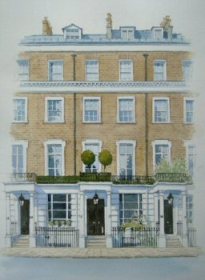
Whilst looking through some papers, I found this old photograph of my ancestral home, Montherlant. From birth I occupied several rooms on the top floor. My nanny's quarters were downstairs. I recall playing tennis in the halls and keeping a family of ducks in a spare room. Amongst the fine paintings and threadbare Persian rugs, I enacted elaborate battles using a collection of toy soldiers. Built in 1702, the estate featured a spacious network of gardens and fish ponds, which, for me, were by far the principal attraction of the place. I have fond memories of exploring the stands of oak trees and flower beds with my pet Greek tortoise, Toby. But it was not to last. When I was still quite young, due to a set of adverse circumstances, as I have previously related here, I was sent away from Montherlant to live with my mother's relative. Montherlant, however, continues to play a significant role in my recollections of the past. In my reveries I imagine my toy soldiers are still in formation and Toby is still keeping watch amongst the oaks, awaiting my return.