14 April 2011

13 April 2011


12 April 2011


10 April 2011
09 April 2011

Lacoste: Dress For Success
 How things change! It's enough to make one laugh out loud.
When I was 10 years old the local long-haired street toughs in New Canaan, Connecticut persecuted me for wearing "preppy" Lacoste shirts and, I suspect, for being better-looking and more successful with the girls. I quickly got over it, bloodying a few noses along the way.
According to cutting-edge scientific research from Europe, however, sporting Lacoste all these years just might have helped me succeed at work and earn a higher salary--while those same New England ruffians today are probably stuck squeezing out anal glands in a suburban pet grooming salon.
Or so I like to imagine.
Scientists at Tilburg University in the Netherlands have just released findings from a unique sartorial experiment. According to The Economist newspaper:
"Rob Nelissen and Marijn Meijers of Tilburg University in the Netherlands examined people’s reactions to experimental stooges who were wearing clothes made by Lacoste and Tommy Hilfiger, two well-known brands that sell what they are pleased to refer to as designer clothing. As the two researchers show in a paper about to be published in Evolution and Human Behavior, such clothes do bring the benefits promised: co-operation from others, job recommendations and even the ability to collect more money when soliciting for charity...
The answer, Dr Nelissen and Dr Meijers suspect, is the same as why the peacock with the best tail gets all the girls. People react to designer labels as signals of underlying quality. Only the best can afford them..."
There are unique implications to this research. Scientists at the The Daily Finance interweb column took these findings and conducted their own comparative analysis. According to their experiments:
"In the midst of college admissions season, there's a useful comparison here: According to research from PayScale Inc., the median starting salary for a graduate of the University of Massachusetts Amherst is $47,000. The median starting salary for a graduate of Brown University--an Ivy League school--is $49,400. That's a difference of about 5.1%."
Compared to a 9% difference between wearing designer versus non-designer wear.
"In other words, wearing a Lacoste shirt to a job interview instead of a no-name shirt would appear to generate a higher starting salary than going to Brown instead of UMass. Another selling point? A Lacoste button-down costs $88 at Macy's, compared with annual tuition and fees of more than $40,000 per year at Brown -- versus about $12,000 at UMass."
Their conclusion?
"So if your kid suggests that you buy him a bunch of luxury clothing instead of sending him to an elite college, don't dismiss him as shallow and shortsighted. He just might be brilliant."
No doubt pompous trads, bolsheviks, hippies, puritans, and anti-Preppites everywhere are spluttering with indignation at this latest confirmation of human nature.
Don't be afraid. Become who you are.
http://www.economist.com/PrinterFriendly.cfm?story_id=18483423
http://www.dailyfinance.com/story/is-a-hermes-bag-a-better-investment-than-an-ivy-league-education/19903224/

08 April 2011


The Country House Revealed: A Secret History of the British Ancestral Home
 "Spanning the architectural history of the country house from the disarming Elizabethan charm of South Wraxall, the classical rigour of Kinross in Scotland, the majesty and ingenuity of Hawksmoor’s Easton Neston, the Palladian sweep of Wentworth Woodhouse, with over 300 rooms and frontage of 600 feet, the imperial exuberance of Clandeboye, through to the ebullient vitality of Lutyens’ Marshcourt, the stories of these houses tell the story of our nation.
All are the are buildings of the greatest architectural interest, each with a fascinating human story to tell, and all remain private homes that are closed to the public. But their owners have opened their doors and allowed Dan Cruickshank to roam the corridors and rummage in the cellars as he teases out the story of each house – who built them, the generations who lived in them, and the families who lost them. Along the way he has uncovered tales of excess and profligacy, tragedy, comedy, power and ambition.
And as these intriguing narratives take shape, Dan shows how the story of each house is inseparable from the social and economic history of Britain. Each one is built as a wave of economic development crests, or crumbles. Each one’s architecture and design is thus expressive of the aims, strengths and frailties of those who built them. Together they plot the psychological, economic and social route map of our country’s ruling class in a rich new telling of our island story."

06 April 2011


05 April 2011
A Moveable Cocktail Party: Metro-North Bar Car

 As you know, for much of the 1990s I worked on Wall Street in lower Manhattan. My last position was in sales at a bank next to WTC. The building later suffered a partial collapse from events on September 11, 2001. I initially lived at family apartment in Zeckendorf Towers at Union Square, but later moved to more civilised surroundings in Greenwich, Connecticut.
 Having grown up near the city and visited it from a young age, I found living in NYC utterly overrated. I concluded the "New York experience" is something pursued mostly by vulgar young people on the make or by outsiders like stuck-up farm bitches from Iowa who think they're too good for their hometown. People who still use their city experience as a bourgeois status marker are boring. New York City? Been there, done that, bitchez. Next.
We drank a lot, mostly off the job. At lunch we would usually head over to New York Dolls, a strip club with a superb lunch buffet. We studied the naked girls in front of us and made pertinent observations to one another. I focused on my favourite girl, a slim, dark Eurasian beauty, staring at her small perfectly-formed tits and neatly trimmed pussy and chewing on some spicy chicken wings. Sometimes after the market closed we would head out to Scores, Flashdancers, and a few other clubs, the names of which I have forgotten. After work we hit Pipeline or various Irish bars surrounding WTC.
Once I moved back to Connecticut I caught the Metro-North train home. Grand Central Terminal is easily one of my favourite places in New York. But the drinking did not stop there. At the head of each tunnel in the Connecticut-bound terminal was a small stand selling cocktails, beers, and snacks. It was an opportunity to stock up for the long 52-minute ride home. Eventually a few of my fellow riders and I decided to hold drinking contests, measuring how many cans of Foster's and Coors Light we could consume without falling over on the way back.
Our arena was the Metro-North bar car, a veritable bar on wheels, added to commuter trains at specially-designated times each evening. It was usually packed with bankers, traders, and attorneys, plus a few women. A rolling cocktail reception. Ragging and teasing abounded. A few old boys played cards. Suits by Brooks Brothers, Southwick, Armani, Hugo Boss, and Paul Stuart. Solid black wingtips, or black loafers by Gucci and Ferragamo. Hair by Subway Barbers in Greenwich. O, happy times.
Nothing good lasts forever. There are rumours the authorities may close down the Connecticut bar car business for good. Let us hope not and instead raise our glasses to the cocktail-swilling commuter class.


03 April 2011

02 April 2011
Saturday Madras
 Handwoven Indian Fabric
This fabric is completely woven on native looms from yarns dyed with authentic Indian colours. The homespun qualities of woven fabric result in no two pieces alike and imperfections such as misweaves, bars, shading, cocktail stains, canapé crumbs, etc. are considered to be inherent characteristics which make woven fabrics so desirable.

01 April 2011
Jolly Country Gent: Crispin Odey
 |
| The hedge fund boss who has had a sausage named after him - the 'Odey sausage' |
A bottle of normally exquisite - and expensive - white Burgundy is produced, which he decides is not quite right. The sommelier scurries away to fetch another one. He glances at the menu and knows what he wants: a duck egg to start, followed by, if I agree, a shared steak and kidney pie. 'And what about some beef on the side, let's have the loin of beef on the side. Lovely. Oh, and we'd better have some mash and some kale - we ought to have something green.'
He calls over the wine waiter again: 'And we'd like a bottle of the Leoville.'
The claret is superb, as is the food. But this is mid-week. A bottle of white and a bottle of red. Beef on the side. Nobody has lunch like this in London, not any more, not in oh-so politically correct, watching-the-calories 2011. Not on this scale and even more rarely at this cost. What's more, with hedge fund magnate Odey, there is the feeling this is nothing special. The office of his firm, Odey Asset Management, is across the road and Corrigans might as well be his canteen.
Recession or no, he lives like this all the time. Full on, doing exactly what he wants to and perish the petty-minded dullards who get in his way.
The phrase larger-than-life could have been invented for Odey. He's well over six foot, broad and has the charm, flamboyance and confidence of someone who is extremely comfortable in his own skin, and is also blessed with a fearsome intellect. His speech is rapid, and ideas, thoughts, opinions pour out of him.
He may look like a jolly country gent down in town for a few days (his passions include fishing and shooting), but he is a financial operator of great aplomb, a man who has the markets constantly in his thrall and is famous for taking daring, often counter-intuitive positions. And he has paid himself at least £85m in the past five years, including over £30m last year.
There again, he is also a hedge fund boss who has had a sausage named after him - the 'Odey sausage'. Made with pork from a neighbour in Ross-on-Wye (where he has a country home), the sausages are sold at the Union Market, the new organic grocer in London. He's in on the deal at both ends, of course - he's an investor in Union Market, and the firm is run by his old friend former corporate financier Tony Bromovsky.
Together with his wife, Nichola Pease, a member of one of the Barclays founding families and deputy chairman of private wealth group JO Hambro (her sister's husband is ex-Barclays chief executive John Varley and her brother Richard Pease is a star fund manager), Odey is part of a formidable and impeccably well-connected unit.
They've been described as the 'Posh and Becks' of the City but in truth they could not be more unlike the celebrity duo. They're part of the old money City establishment, highly educated, conservative in taste, quiet, serious and never courting publicity. They're extremely wealthy - the Sunday Times Rich List estimates their worth at £300m.
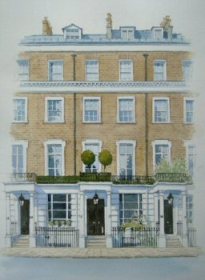
But in that, too, Odey, 52, is quite different from his hedge fund rivals. He's absolutely not brash - the Odeys and their three children live in London, in a gorgeous but understated, art and book-filled house in the oldest part of Chelsea, near the river."
Cont...
The MT Interview: Crispin Odey, by Chris Blackhurst, Management Today, 1 April 2011
http://www.managementtoday.co.uk/go/news/article/1061079/the-mt-interview-crispin-odey/
© Haymarket Business Media 2011

Subscribe to:
Posts (Atom)