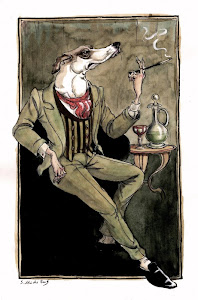
The word on the street is that I am some sort of royalist. For once they are right: I am, indeed, avowedly so. Monarchy is the most natural form of government and I am a natural kind of chap. I would much sooner be ruled by an hereditary monarch than by the ambitious, grasping, power-hungry products of a so-called meritocracy and party-political system. When it comes to the sacrament of marriage, however, I am rather less sanguine, in light of recent events. But never mind. I plan to celebrate the nuptials of H.R.H. Prince William of Wales and Catherine Middleton with determination and a smile, cocktails-at-the-ready as always.
  I rarely pass up the opportunity to spread a bit of gossip if it makes the competition look foolish. A correspondent in the office of a rival financial firm in Southern California has written to me. It appears the managing director there has imposed on the stockbrokers a "dimple rule" pertaining to the wearing of neck ties. All ties are to be dimpled, declares the manager, even going so far as to hold regular morning inspections of his staff. Miscreants are sent to the bog where they are expected to re-do their tie until they get it right. WTF?! It seems rather extreme. Maintaining a dimple in one's tie has always struck me as trying too hard, the mark of the grasping amateur, a concern of awkward i-gents on the interwebs. Certain neck ties lend themselves to a dimple; others do not. Technique aside, it is largely due to type and quality of cloth. So what can we conclude from this? Clients should re-assess their allegiance to a firm whose priorities are so glaringly focused elsewhere.
 |
| Laguna Beach Bikinis |
 Poolside cocktails at noon. The Southern California sun shines and the drinks flow like the Trevi fountain, and yet my reveries are interrupted by the cries and panting of young people who run about the place like wild animals. It is most irritating. I do not ask much from life, but I do require on occasion some peace and quiet. I do my best work slipping away somewhere else. In fact I am almost there now.
 "Last week, during Cleverley's spring visit to New York, Glasgow received a package from an old customer containing the spectacularly aged Derbies you see above. Dating to 1968 (all Cleverley's unique shoes are marked by hand inside with the year of their construction), they have taken many steps; they've received, at one stage or another, the shoemaker's equivalent of intensive care; they've continued to be lovingly polished, and worn a full forty-three years after they rolled off the bench of the original Mr. George. The anonymous customer, now in his seventies, left a note inside the shoes — one filled with suitable understatment: "I think it's time to replace this pair, although I'm worried the new shoes will be too new for the wooden box.""
  I can report--in an Admiral Cod exclusive--that the first G&T of the summer season was consumed this past weekend in Southern California. Here in the Southern hemisphere, where the sun shines 325 days of the year, G&Ts, madras, seersucker, and white bucks make an earlier appearance than their counterparts in the North. And for that I am most thankful. For lunch we sat in the sun on the water. As you know my gin of choice is Bombay Sapphire and has been for many years. Its striking blue colour reminds me not only of my beloved's eyes, but also of native Baltic seas for which my northern heart continues to ache. English gin produces over time a sensation of fruit bat-shit crazy, her power in my experience rivalled only by absinthe, opium, and other frowned-upon substances. After lunch we walked along the pier taking care to avoid the pigeon shit and strutting African tourists. Young surfers bobbed and weaved below us, pigging-out on crowded waves and occasionally erupting into fights, tanned blonde lads spinning in the green room. We are joyful refugees from the prying eyes of long-haired commissars from the Laguna Beach Groundnut Collective, tie-dyed and addled, whose hippy drum circles dot the coastal region tapping out a continuous death-knell to young fogey and preppy alike. Woe to those who ignore its song. In the meantime, there are cocktails to be enjoyed under the southern sun. The first gin of the season is a gift and an occasion to celebrate.
 "A fogey is a culturally conservative young person, prematurely young you might say, who adopts the clothing, style, and mannerisms of a bygone age. The key reference here is Evelyn Waugh's Brideshead Revisited, a public school and Oxbridge world inhabited by tweed wearing, reserved (if not repressed) and wilfully eccentric young men. Adopting these mannerisms is a mark of the fogey's cultural distinctiveness and sets them apart from the trends that tend more normally to mark the life of the young. The idea of the fogey is a uesful way of thinking about Tory anarchists of all stripes as it encapsulates the nostalgic utopianism for the past that they convey in aspects of their work and in their critiques of contemporary mores. Whilst is it often a term associated with figures attached to the Daily Telegraph newspaper, it is just as useful as an insight into the world of the Tory anarchist. The term 'fogey' is an old British phrase that dates back several hundred years and refers to 'old-fashioned' people. The term 'young fogey', by contrast, was first put forward by the journalist Alan Watkins in the Spectator magazine in 1984 when he said of them:
 "Brooks Brothers introduced madras clothing to this country at the end of the last century, but it wasn't until the 1930s that it really became popular. Vacationers to the Caribbean had first spotted the fabric being worn by West Indian natives, and before long shorts and swim trunks, sports jackets and golf trousers were all the rage round the links and club pool. By the 1950s there was not a campus in the country that didn't sport a full complement of plaid Bermuda shorts on male and female students alike--worn either with tennis shoes or with knee-high hose and dress shoes, English-style. The denim mania of the sixties and seventies dampened enthusiasm for madras in some quarters, but it remains, along with polo shirts and penny loafers, very much a part of the Eastern Establishment summer uniform.