Showing posts with label Thesiger. Show all posts

25 February 2012

Wilfred Thesiger: A Charmed Existence

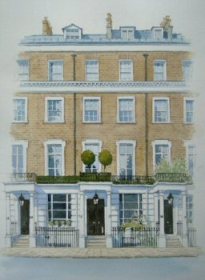
I met Wilfred Thesiger for the first time in June 1964 at his mother's top-storey flat in Chelsea. He was then aged fifty-four. He was sunburnt, tall, with broad shoulders and with deep-set grey eyes. As we shook hands I noticed the exceptional length of his fingers. He wore an obviously well-cut, rather loose-fitting dark suit. I remember clearly that he smelt of brilliantine and mothballs. He spoke quietly, with an air of understated authority. His voice was high-pitched and nasal; even by the standards of that time, his rarified pronunciation seemed oddly affected. He had a distinctive habit of emphasising prepositions in phrases such as 'All this was utterly meaningless to me'. He moved slowly and deliberately, with long ponderous strides; yet he gave somehow the impression he was also capable of lightning fast reactions. Later, I heard that he had been a source of inspiration for Ian Fleming's fictional hero James Bond. Whether or not this was true, Thesiger, like Bond, was larger than life; and, like Bond, he appeared to have led a charmed existence.

Wilfred Thesiger: The Life of the Great Explorer, Alexander Maitland (2007)

29 October 2010

Thesiger & Young (1979)

14 August 2010

Thesiger's Tribe

"Since Thesiger lived much of his life among foreign tribes, it is apposite to examine the nature of the tribe into which he himself was born in 1910. First of all, it was a tribe. The British aristocracy was socially exclusive, highly interbred, and despite being imbued with the ideals of duty, loyalty and service, owed allegiance to itself rather than to an abstract idea of 'Britain'. It might be said that for them, 'Britain' was the aristocracy, irrespective of the fact that they represented only 2 per cent of its population. In 1910 they were still distinguishable physically from the other classes: they were taller, more robust, and possessed a distinctive similarity of physical cast--jutting chins, oriental cheekbones, kedge-like noses, deep-set eyes. They were set apart, too, by the elegance of their attire, for in a world without dry-cleaning only the toff could afford to have his suit unstitched and the parts washed piecemeal."

Thesiger, Michael Asher (1994)

01 August 2010

Thesiger: Archeo-Traditionalist

"Thesiger has rightly been called 'old-fashioned' and 'a throwback to the Victorian era,' yet in one sense his views were ahead of their time. Even as a boy he foresaw the way in which technology would ride like a juggernaut across the earth, devastating what was priceless in traditional life. All his life he saw technology as an intrusion into the unspoiled world, and as a barrier between man and nature. Traditional peoples were to him the most significant aspect of the environment, and truly to understand them, he believed, one must live as they lived--eating the same food, drinking the same water, enduring the same privations, facing danger shoulder to shoulder, accepting common rules of behaviour. What generated this unique attitude was Thesiger's need to express certain ideals which the technetronic twentieth century was quickly discarding. In a society run by machines, the traditional values that govern the idea of manhood disintegrate. Courage, the warrior-instinct, close loyalty to companions, even hospitality, dignity, stoic endurance and honesty, become irrelevant. Thesiger believed that technological society tended to breed selfish individuals, mostly concerned with amassing material wealth. He stood out all his life against this disintegration of traditional values, living by a personal code of integrity he never lost. Summed up, perhaps, by the concept of 'nobility'--a quality he claimed to find in both kings and illiterate tribesmen alike--he believed that these ideals were developed to their fullest extent among the Bedu of Arabia, whose ethic of miruwa, or 'manliness'--courage, loyalty, endurance, hospitality and generosity--matched almost perfectly with his own."

Thesiger, Michael Asher (1994)

25 April 2010

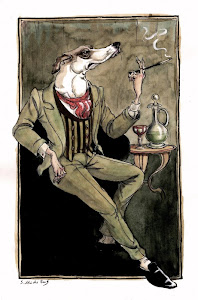
Thesiger: Three-Piece Suit

27 May 2008

Epic Englishman

Some men love people. Others have a fondness for things. And then there are those who love places most of all. I think the English explorer Wilfred Thesiger (1910-2003) probably fell into the last category. Born in Abyssinia (Ethiopia) and educated at Eton and Oxford, Thesiger spent a lifetime exploring Africa, the Middle East, and Central Asia. His many books, such as Arabian Sands (1959) and Marsh Arabs (1964), are testament to his wanderings and keen insights. He was a talented photographer. Thesiger twice crossed the Empty Quarter of the Arabian peninsula by foot and camel. An aristocrat who maintained a flat in Chelsea and who wore impeccable three-piece suits and tweed jackets from Savile Row, he sympathised strongly with savage peoples untouched by modernity. I highly recommend his outstanding autobiography, A Life of My Choice (1987). Great and unsusual men like Thesiger are increasingly rare in a shrinking, homogenised world. I doubt we will ever see his kind again.