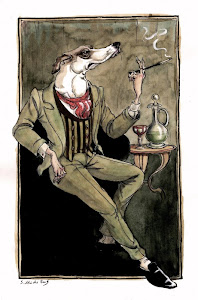
I collect rare books. Or should I say: I did once, but no longer. It is a solitary pastime, I have long suspected but only recently reluctantly concluded, that renders one unfit for common human company, especially of the long-term female sort, an inference which by the way only confirms those qualities once publicly deduced by the individuals in closest physical proximity to me in my early youth. So be it. Fuck them. And damn them. And God's speed to them if I should ever meet them in a dark mews somewhere. For few modern people here I have discovered over the decades actually read proper books. It is a serious flaw, a widespread civilisational deficiency. Am I the only one here taking notes? Must I kick arse as well?
As a schoolboy at Templer College in the late 1980s I developed a strong interest in the Brideshead Generation, as a portrait by Humphrey Carpenter once succinctly put it, thanks in part to the scholarly Jesuit priests in whom my people placed my adolescent intellectual development and soule for safe-keeping. (God bless the Jesuit fathers for without their influence I would be more of a violent beaste than I am already). I therefore distributed inquiries to rare book agents in London and New York for first editions of works by Waugh, Powell, Green, Byron, et. al., and collected a fair number as a result. Two surviving members are pictured here in this column (above).
My interest naturally followed me to university, where I studied political philosophy and economics, when I was not playing rugby, rowing, drinking, fucking, and fighting. I spent most evenings in the cathedral library cellars, however, reading and re-reading the Brideshead curriculum, amongst other things, before heading out betweeded to the castle ale-hall. In those days of floppy side-parted hair, bitter-stained cords, and thick chestnut brogues, it did not help that one of my favourite drinking chums was a dead-ringer for the actor Jeremy Irons of televisual Brideshead Revisited renown. My imagination was on over-load.

And now on to Anthony Powell. In recent weeks his books have infiltrated my absinthe and codeine-saturated consciousness. I must say, it is a good thing to be able to settle down to a Powell novel in the 'A Dance To the Music of Time' series after a long day doing battle with the Kenneth Widmerpools of the world. The character Widmerpool is a stinking abomination, a modern Grendel in three-piece suit begging for slaughter. Grossly fat, ambitious, corrupt, deviant, pig-like, sharply aware of his core inferiority, leaking rank blood-streaked puss from his very centre, Widmerpool is a slave to fad and youthful rebellion and a socialist traitor to his country wherever he goes. He is modern Western man personified.
As I have discovered, Widmerpools are far more numerous than Powell has led us to believe, I can report, and their suppression requires bigger guns than mere English novelists can muster. It also requires more accurate artillery. Widmerpools over-populate the main centres of influence; indeed you can smell their ancient filth from here. Do you know a Widmerpool? If so, would you be able to point him out in the street to me and my droogs? Do let us know. It is very important.
Anthony Powell's observant yet detached attitude toward his times and contemporaries is entirely appropriate for an artist of his generation. But today, I think, we can ill afford to be so complacent. You have been warned. It is important to be a man of thought and deed, to have the courage to walk right into the sun and to go out like a supernova. We must take action, for the last hours are drawing nigh.


 And now on to Anthony Powell. In recent weeks his books have infiltrated my absinthe and codeine-saturated consciousness. I must say, it is a good thing to be able to settle down to a Powell novel in the 'A Dance To the Music of Time' series after a long day doing battle with the Kenneth Widmerpools of the world. The character Widmerpool is a stinking abomination, a modern Grendel in three-piece suit begging for slaughter. Grossly fat, ambitious, corrupt, deviant, pig-like, sharply aware of his core inferiority, leaking rank blood-streaked puss from his very centre, Widmerpool is a slave to fad and youthful rebellion and a socialist traitor to his country wherever he goes. He is modern Western man personified.


 As a columnist I often receive e-mailed requests to post pictures of my summer kit. I tend to hesitate due to privacy concerns, as you can understand, but an occasional glimpse behind the madras curtain should cause no harm. The photograph (at left) represents a typical outfit. The shirt is Lacoste and the boat shoes Sperry Topsiders. The shoes, a gift from a now-departed lady friend, like me, have a dark sole. The shorts, in lobster seersucker, are a special acquisition from J.Crew. In the era of t-shirts, denyme trousers, and flop-flips, summer kit is a provocative uniform, I realise, but I am well-prepared to defend the gesture. Try me. Should you spot me at a local beach margarita shop holding court with my chums, come over and say hello. I will buy you a cocktail, compliment you on your smashing tan, and inquire after your family. I promise not to talk about the stock market. Can you feel the magic? Do not be anxious if at the end of the evening we find ourselves growing closer. The lobsters don't bite, usually.